Author: mike
-
FTC to Hold Informal Hearing on Fake Review Rule
The Federal Trade Commission has scheduled an informal hearing on its proposed rule banning fake reviews and testimonials. The hearing will be held at 10am ET on Tuesday, February 13. Why This Matters: A handful of organizations — Advertising Bureau, Fake Review Watch, and a group of academic researchers — have asked the FTC for…
-

Judge Denies MTD in TCPA Case Against Lead Generator
A District Court judge in Maryland has denied a defendant’s motion to dismiss after it was sued for violating the Telephone Consumer Protection Act by sending text messages seeking to buy homes in any condition to individuals who did not provide prior consent to receiving the messages. The Background: The defendant, MarketPro, is a real…
-

FTC Sues, Settles Case Against Lead Generator
The Federal Trade Commission has announced a settlement with a lead generation company and its owner that will see them banned from making robocalls or calls to numbers on the Do Not Call list after they were accused of operating more than 50 sites designed to trick consumers into providing their personal information for mortgage…
-

FCC Adopts Rule Closing Lead Generator Loophole, But Gives Companies 12 Months to Get Ready
The Federal Communications Commission yesterday published the final rulemaking document laying out changes it voted on during its meeting last week, but did make one compromised at the request of the Online Lenders Alliance, agreeing to allow 12 months for companies to make the necessary changes to comply, instead of the six months that was…
-

The Need for Improved Spam Tags
In the fast-paced world of marketing and lead generation, professionals must stay informed about evolving telecommunication policies, particularly regarding spam caller notifications. Recent discussions, notably at the VON Evolution conference, have highlighted critical concerns and proposed solutions in this area, according to a published report. The core issue revolves around the Federal Communications Commission’s STIR/SHAKEN…
-
FTC Orders Scammers Selling Bogus Telemarketing Advice to Repay $1M to Consumers
The Federal Trade Commission has entered into an enforcement action with a group of companies that will require them to repay $1 million in consumer refunds after falsely promising to consumers that they could make millions in telemarketing sales. Who’s Involved: The companies were owned by Taylor Welch and Christopher Evans. Payton Welch and Ashton…
-
Webinar Recording: How Lead Generation Will Work in a post-FCC Ruling World
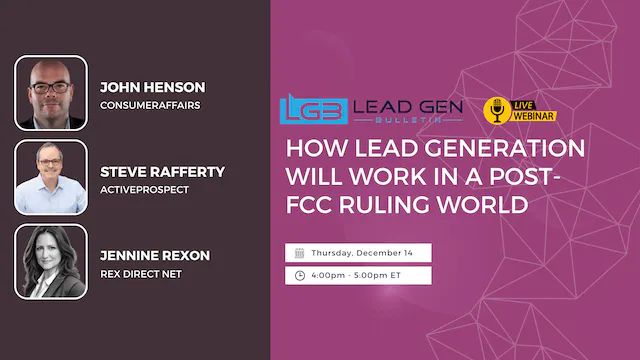
Here are the five most important takeaways from this webinar: Click here to access a recording of this webinar.
-

FCC Votes to Close Lead Generator Loophole
The Federal Communications Commission has voted to close a loophole that allowed companies to sell leads to multiple buyers, instead requiring companies obtain consent from consumers to share leads with one buyer at a time. Known as the lead generator loophole, it allowed consumers to be contacted by virtually anyone. How it Will Work: Consumers…
-
The FCC’s Proposed Changes to Lead Generation Explained
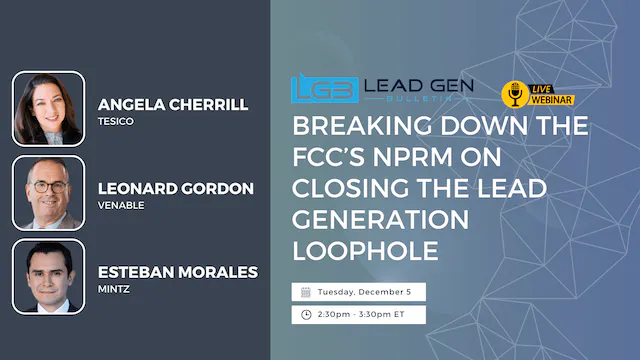
On December 13th, the FCC is expected to vote on a proposed rule that would dramatically change the lead generation industry. The rule aims to close what the FCC sees as the “lead generation loophole” – obtaining consumer consent for multiple companies without specifying each one. The panel discussion provided insight into the proposed rule.…
-

Appeals Court Upholds Denial of Motion to Compel Arbitration Filed by Insurance Lead Generator
The Court of Appeals for the Third Circuit has affirmed a lower court’s ruling ordering the two sides in a discrimination case to conduct discovery on whether the defendant, an insurance lead generation company, can force arbitration after an employee who underwent heart surgery was dismissed. The issue is that the motion to compel arbitration…